

Kids on a Yacht Charter in Miami: Life Jacket Laws and Tips
Mariam Revuelta
Taking children on a yacht charter in Miami starts with choosing a suitable boat, confirming properly fitted life jackets, and planning for supervision, shade, and rest. Your children’s ages, the vessel, and the route all shape what you need for a comfortable family day on the water.
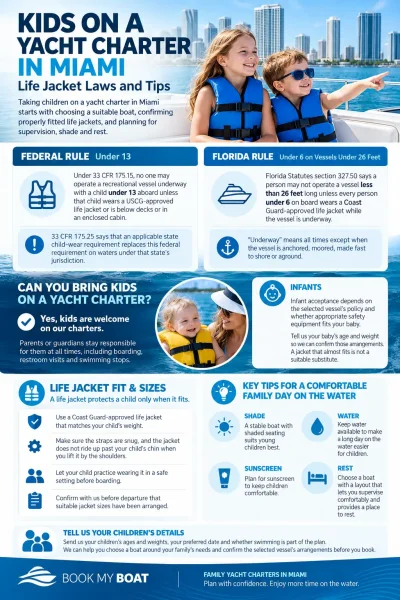
Florida requires children under 6 to wear a USCG-approved life jacket while underway on vessels under 26 feet. The federal under-13 rule has an exception for waters where a state's child-wear requirement applies. The vessel, route and captain's safety rules matter, so a single age cutoff does not describe every Miami charter.
At Book My Boat, we help you choose a boat around your family's needs. Send us your children's ages and weights, your preferred date and whether swimming is part of the plan. We can confirm the selected vessel's arrangements before you book.
Key Takeaways
The federal under-13 rule has cabin exceptions and a state-jurisdiction exception; Florida has its own child-wear requirement.
Florida also requires children under 6 to wear one on vessels under 26 feet.
Tell us each child's age and weight when you request a quote so we can confirm suitable jacket sizes for your selected vessel.
Shade, water and sunscreen make a long day on the water easier for children.
A stable boat with shaded seating and a cabin suits young children best.
Can You Bring Kids on a Yacht Charter in Miami?
Yes, kids are welcome on our charters, and parents or guardians stay responsible for them at all times. Plan for a parent or guardian to supervise children throughout the trip, including boarding, restroom visits and swimming stops.
Infant acceptance depends on the selected vessel's policy and whether appropriate safety equipment fits your baby. Tell us your baby's age and weight so we can confirm those arrangements. For babies on a boat, a jacket that almost fits is not a suitable substitute.
Life Jacket Rules for Children: Federal and Florida
The child life jacket law in Florida needs to be read alongside federal rules and the waters where the vessel operates. Legal minimums and onboard safety rules can differ. A captain may require life jackets even where continuous wear is not legally required, and a properly fitted jacket is a sensible precaution on an exposed deck.
The Federal Rule: Under 13
Under 33 CFR 175.15, no one may operate a recreational vessel underway with a child under 13 aboard unless that child wears a Coast Guard-approved life jacket or is below decks or in an enclosed cabin. The Coast Guard's boating safety office states the same rule and adds that state laws may vary.
However, 33 CFR 175.25 says that an applicable state child-wear requirement replaces this federal requirement on waters under that state's jurisdiction. Requirements depend on the waters where your charter operates. We can help confirm the requirements for the selected vessel and itinerary.
The Florida Rule: Under 6 on Vessels Under 26 Feet
Florida Statutes section 327.50 says a person may not operate a vessel less than 26 feet long unless every person under 6 on board wears a Coast Guard-approved life jacket while the vessel is underway. The statute defines "underway" as all times except when the vessel is anchored, moored, made fast to shore or aground.
The current Florida statute retains this requirement. A yacht's length does not remove the need for suitable safety equipment or compliance with its captain's rules. The federal age threshold is under 13 where that rule applies, not under 12; its state-jurisdiction exception still matters.
Fit, Sizes and Pre-Booking Confirmation
A life jacket protects a child only when it fits, so adult jackets are not a substitute. Send us each child's age and weight so we can confirm appropriate sizes and any arrangements for your selected vessel. Do not assume that every boat stocks every infant or child size. Here is what to check when you board:
The jacket carries a Coast Guard approval label and matches your child's weight.
The straps are snug, and the jacket does not ride up past your child's chin when you lift it by the shoulders.
Let your child practice wearing it in a safe setting before boarding.
Confirm with us before departure that suitable jacket sizes have been arranged.
The USCG's life-jacket FAQs explain sizing and restrictions for inflatable devices. Follow the approval label's size and use instructions. Follow the individual jacket's approved weight range and fit instructions. If no approved device fits your baby, don't assume holding them will replace it.
Best Boats for Families With Young Children
Before comparing listings, picture your family's routine: boarding with bags, helping a child use the restroom, sitting together for snacks and finding a place to rest. A large deck is useful only if its layout lets you supervise comfortably. Wide walkways, secure seating and convenient access between shaded areas can matter more than extra length.
Tell us whether your group includes a toddler who needs constant close attention, a school-age child who wants to swim or a teenager who prefers sightseeing. Boating with kids in Miami works best when the route and onboard setup suit the whole group. A shorter outing may be easier for a first trip than an extended offshore itinerary.
The best boat for a family has a steady deck, plenty of shade and easy access to a cabin or shaded seating. Layout counts for more than size, so look for space where a toddler cannot reach the rail quickly. Here is how the main boat types compare:
Motor yachts offer shaded salons, a cabin for naps and rails around the deck, and our guide to choosing yacht size by guest count helps you pick the right length.
Catamarans have a wide beam and big deck areas, which many families find comfortable, and you can browse them on our catamaran charter page.
Pontoon boats have open, flat decks that suit short bay trips, and you can see them on our pontoon boat rentals page.
For a larger celebration with children, our party boat rental guide covers capacity and house rules. You can also browse stable family boats on our search page and tell us how many children are coming. A family-friendly boat rental in Miami should match the youngest guest, the planned route and the time you expect to spend aboard.
How Should Adults Divide Supervision Onboard?
Name the adults responsible for supervision and agree on clear handoffs, especially during boarding, swimming and restroom breaks. Keep children within sight and follow the captain's briefing. The crew handles vessel operations; parents and guardians remain responsible for childcare.
We do not set a universal adult-to-child ratio, because the right number depends on the children's ages and swimming ability. Agree on the plan before you leave the dock. The American Academy of Pediatrics' water-safety guidance emphasizes attentive supervision alongside other protection. A life jacket complements supervision; it does not replace it.
What Safety Rules Should Children Know Before Departure?
Children should know a few simple rules, and it helps when a parent repeats them after the captain's briefing. Use plain, age-appropriate words.
Walk on deck instead of running.
Stay in approved seating while the boat is underway.
Never ride on the rails, bow edges or swim platform while the vessel is underway.
Ask an adult and the captain before entering the water.
Know which areas are off-limits and which adult to call for help.
The FWC's passenger safety guidance covers safe seating and other onboard precautions. Repeat the rules calmly and check that children understand them.
Kids by Age: What to Expect
Each age group needs something different, mostly in jacket fit, shade, rest and supervision. Use the table as a starting point and adjust for your own child.
Age | Life jacket | Shade and rest | Supervision |
|---|---|---|---|
Infants | Infant-size jacket fitted by weight | Shade; suitable supervised rest space | Hold or stay within arm's reach |
Toddlers | Child-size jacket on deck | Shaded seating, water breaks | One adult watching at all times |
Ages 5 to 8 | Fit by weight; wear as required for route and vessel | Hats, shade, snack breaks | Stay close near the swim platform |
Tweens | Fit by weight; wear as required for route and vessel | Sunscreen on a schedule | Set clear rules for rails and water |
Teens | Fit and label matter; follow vessel rules | Water and shade | Agree on boundaries before swimming |
Activities for Children Who Do Not Swim
Let children know before departure that swimming is optional. A child who feels nervous should not be pressured to enter the water because others are doing it. Agree on an onboard activity for that time and make sure an adult stays with children who remain aboard rather than leaving the entire family in the water.
Choose quiet activities that will not roll across the deck or blow overboard. A small book, reusable drawing pad or a short list of landmarks can work better than loose craft supplies. Keep photography in approved areas; a good view does not justify leaning over a rail.
A day on the water does not need swimming to be fun. Children can spot Miami's skyline and passing boats, play simple seated games or hunt for photos on a scavenger list. We can confirm which spaces and activities suit your selected boat. Keep games in approved seating areas and save exploring the deck for times when the crew permits it.
Sun, Heat and Hydration
Children need shade, plenty of water and regular sunscreen on a Miami boat day. Water reflects sunlight, so burns can come quickly even when the breeze feels cool.
The American Academy of Pediatrics' HealthyChildren.org recommends keeping babies under 6 months out of direct sun, and using a broad-spectrum sunscreen with SPF 15 to 50, reapplied every 2 hours and after swimming. We suggest these basics:
Apply sunscreen on the dock before you board.
Pack hats and swim shirts.
Bring a water bottle for each child and offer sips often.
Choose a boat with usable shaded seating and move children out of direct sun as needed.
For infants, prioritize shade and protective clothing. Discuss individual sun-protection needs with your pediatrician, especially for babies under 6 months. A product described as reef-safe does not replace SPF protection or shade.
Sandbar Days With Children
A sandbar can be a fun stop for kids when an adult stays close and the children wear properly fitted, USCG-approved life jackets. Our guides to the Haulover sandbar and the Nixon sandbar at Key Biscayne cover planning for those stops, and our overview of the best sandbars in Miami compares local stops. Tides, currents, weather, and boat traffic can change the conditions. Enter only after the captain approves the stop and explains the safe entry area. Here is a checklist for the water:
Keep one adult within arm's reach of every young child in the water.
Keep jackets on non-swimmers while they are in the water.
Enter from the swim platform or ladder, one child at a time.
Stay clear of the marked boating channel and watch for moving boats.
Count heads whenever the group moves.
Skip water entry if conditions or supervision are unsuitable. A skyline cruise can still give your family a memorable outing.
Naps, Changing and Snacks Onboard
A cabin is a layout feature, not a promise that a boat provides an infant-safe sleep setup. Tell us what your child needs and confirm the space before booking. Keep supervising children during rest periods, and don't assume an unfamiliar berth or salon seat suits your baby's usual sleep arrangements.
Pack familiar snacks in portions you can serve easily while seated. Share allergies or dietary restrictions if you are arranging catering, and confirm the service rather than assuming an allergen-free preparation area. Keep wipes and a bag for used diapers accessible, and use the designated waste arrangements instead of putting wipes into marine toilets.
Tell us if your children need a nap space, changing area or regular snack breaks so we can confirm the selected boat's layout before booking. Some yachts have a cabin with a bed or a shaded salon, and others have only open seating. We can confirm space for a changing mat and where food may be served. Our guide to what is included in a charter price explains how to review package inclusions; your booking confirmation establishes what is included for your boat.
What to Pack for a Child on a Boat
Pack for comfort and surprises, since a dry, fed and shaded child is a happy passenger. Here is a kid-specific list:
Spare clothes and a towel for each child.
Diapers, wipes and a changing mat.
Snacks and a water bottle for each child.
A favorite toy or book for quiet moments.
Familiar comfort items and supplies for your child's usual motion-sickness plan; discuss medication with their pediatrician.
How to Book Your Family Charter
Include every child in your guest count, even infants. Do not assume that a small child is exempt from the boat's approved passenger capacity. Tell us how many adults are coming too, and whether anyone has mobility needs that affect boarding, stairs or access to the restroom.
Describe your preferred day as well as your budget. A sightseeing cruise, a swimming stop and a celebration create different needs for shade, seating and time aboard. We can help you compare suitable options without promising that every vessel has the same amenities. If weather changes the route, an onboard activity plan helps keep children comfortable.
For a family yacht charter in Miami, send us the information below with your quote request. We can check the details that matter before you choose a vessel.
Share every child's age and weight so we can confirm the right jacket sizes.
Tell us whether shaded seating, a cabin, easy boarding or a restroom is essential.
Confirm that the captain will give a safety briefing before departure.
For a holiday trip, our July 4th yacht charter guide covers fireworks planning, and our month-by-month guide explains seasonal conditions. Birthday trips are common too, and our birthday charter page answers questions about kids on board.
Frequently Asked Questions
Do kids have to wear life jackets on a charter boat in Florida?
Florida requires children under 6 to wear USCG-approved life jackets on vessels under 26 feet while underway. The federal under-13 requirement applies where applicable, with cabin exceptions; state child-wear rules replace it in state-jurisdiction waters. Vessel and captain policies may be stricter. We can confirm arrangements for your selected boat and route.
Can a 12-year-old wear an inflatable life jacket?
No, an inflatable life jacket is not an appropriate choice for meeting a 12-year-old's USCG life-jacket requirements. Follow the device's approval label and select a properly fitted, child-appropriate wearable jacket. Swimming ability does not override label restrictions. Ordinary pool floaties, inflatable toys and swim aids are not substitutes for an approved life jacket.
Is there an age limit for babies on a boat rental?
Infant acceptance depends on the selected vessel's policy and suitable safety equipment; we do not offer a universal minimum booking age. Send us your baby's age and weight before booking so we can confirm the boat's arrangements. A properly fitted, approved life jacket is essential, and holding a baby does not replace it.
Can I bring a stroller on a yacht charter?
Stroller permission depends on the boat's boarding access, layout and storage space. Tell us its folded dimensions so we can confirm whether it is permitted before you book. Keep walkways and emergency access clear. A stroller is not a safety device and does not replace a properly fitted life jacket or attentive adult supervision.
Do charter companies provide child-size life jackets?
Availability and sizes vary by vessel. Send us each child's age and weight with your quote request so we can confirm suitable jackets for your selected boat. Do not assume that an adult jacket or a larger child's jacket will fit. If you plan to bring your own, it must meet applicable approval and fit requirements.
Is the Miami sandbar safe for kids?
A sandbar stop needs suitable conditions, approved water entry and close adult supervision. Keep young children within arm's reach and non-swimmers in properly fitted, approved life jackets. Water depth, currents and boat traffic can change, so shallow-looking water is not a safety guarantee. Our sandbar guides help with planning, and swimming can remain optional.
Can you use a car seat on a boat?
Do not treat a car seat as boating safety equipment or a substitute for a properly fitted life jacket. It is designed for vehicle travel, and its restraints are not a boating flotation system. Tell us about your infant's needs so we can confirm suitable arrangements. We can also confirm where travel equipment may be stored without blocking walkways or emergency access.
Plan a Family-Friendly Day on the Water
Browse Book My Boat’s family-friendly options and send us your preferred date, guest count and each child’s age and weight. Tell us whether shade, a rest space or a swimming stop matters most. We’ll help you compare boats and confirm arrangements for your selected vessel before you book.