

What Size Yacht Do You Need? A Guide by Guest Count
Mariam Revuelta
Rough rule: allow about four feet of boat per guest, and your day gets a lot more comfortable. That's a comfort guideline, not a legal one, and the two are different numbers. This guide covers what each length actually holds, what it feels like when it's full, and where the price steps up between tiers.
Key Takeaways
Four feet of boat per guest is the comfort rule. Legal capacity is usually higher.
Most crewed charters cap at 12 or 13 guests regardless of length.
A boat at maximum capacity seats roughly two thirds of that number in shade.
Four tiers cover everything: 40 to 50 ft, 50 to 70 ft, 70 to 90 ft, and 90 ft plus.
Anything over 13 guests needs an inspected passenger vessel, which changes the price band.
The Quick Rule: Guests to Length
Take your headcount and multiply by four to get a comfortable length. Six guests suits a 40 ft boat. Twelve guests wants 50 to 60 ft. Above thirteen, you move into a different vessel class entirely.
Length | Legal capacity | Comfortable | Heads | Shaded seats | Hourly from |
|---|---|---|---|---|---|
37 to 45 ft | 13 | 6 to 8 | 1 | 4 to 6 | $145 |
50 to 60 ft | 13 | 8 to 10 | 1 to 2 | 6 to 8 | $180 |
60 to 70 ft | 13 to 15 | 10 to 13 | 2 | 8 to 12 | $250 |
75 ft | 20 to 25 | 16 to 20 | 3 | 14 to 18 | $1,000 |
90 ft | 30 to 49 | 24 to 35 | 4 | 20 to 30 | $1,400 |
100 ft plus | 100 to 375 | By vessel license | 4 to 6 | By layout | $1,500 |
Read the table as two separate answers. Legal capacity tells you whether a booking is allowed. Comfortable capacity tells you whether the day is any good. Groups that book to the legal number and stay out for eight hours are the ones who wish they'd sized up.
Legal Capacity vs Comfortable Capacity
Legal capacity is what the Coast Guard allows for the vessel's license. Comfortable capacity is how many people can sit down, get shade, and reach a bathroom without a queue. They're rarely the same number.
A useful habit: take the listed maximum and subtract about a third. A boat rated for 13 seats roughly nine people in shade at once. The rest are standing, on the bow in full sun, or waiting for a seat. On a two-hour sunset run that's fine. On a full day, it's the thing people remember.
Bathrooms follow the same logic. One head is fine for six people on a short run and tiring for twelve across a full day. Count heads against your headcount and your hours together, since the two multiply rather than add. That comfort math follows the same thinking behind ABYC's load capacity standards for recreational boats, while Florida's boating regulations layer state rules on top of the federal ones.
How Yacht Layout Changes the Space You Need
Length is a starting point, not an answer. Two 60 ft yachts can feel completely different with the same twelve people aboard.
Compare the parts that hold people: open bow seating, flybridge seating, cockpit size, salon space, shaded areas, bathrooms, cabins, and the swim platform. One 60-footer might run a big flybridge and a small cockpit, while another has an air-conditioned salon and almost no shade outside.
So narrow by guest count first, then compare photos and layouts on the listings that survive. Ten minutes of looking at deck plans beats any rule of thumb. You can browse the fleet to see real layouts side by side.
40 to 50 ft: Couples and Small Groups
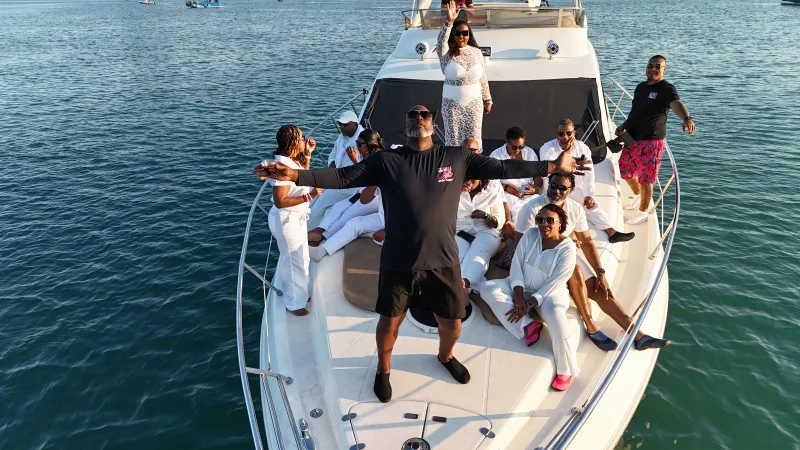
A lovely tier, and the easiest place to start. Expect one head, a bimini for shade, a swim platform, and rates from about $145 an hour. Six to eight guests fit comfortably.
What it does well is a short sandbar run, a sunset loop, or a first time on the water. What it doesn't do is overnight, large catering, or a choppy day offshore. Small boat charters cover the smallest end of the fleet.
The draft helps too. Smaller hulls sit shallower, which means they can tuck closer in at a sandbar and make the swim easier. Big boats have to anchor further out and tender guests across.
50 to 70 ft: The Most Booked Range
This is the workhorse, and it's where the value sits. Flybridge seating, a second head on many boats, a real galley, and a hull that stays steadier once guests move around. Rates run roughly $180 to $400 an hour.
Groups of eight to thirteen almost always land here, and the per-person cost bottoms out in this band. Thirteen guests on a $250 boat works out near $77 each for four hours before extras. Nothing above or below this tier beats that.
Stability is the underrated part. Extra length and beam settle the ride when the bay chops up in the afternoon, which matters for anyone prone to motion sickness. It's a real reason to size up beyond seating alone.
70 to 90 ft: Events and Overnights
Crew count jumps here, and that's what you're paying for. A 75 ft yacht runs a captain, two mates, and a stewardess at about $1,000 an hour, with three staterooms. A 90-footer adds full crew and a chef option at around $1,400, with four staterooms.
Guest ceilings rise to 20 to 25 and then 30 to 49, though capacity doesn't scale neatly with length. It depends on the vessel's license rather than its size. Large yacht charters list what's available in this band.
90 ft and Up: Mega Yacht Territory
Full crew, tender and toy storage, and serious interior space. An 88 ft Ferretti Custom Line lists at $2,700 an hour, and a 98 ft Princess runs around $3,000 for up to 49 guests.
The interesting part is the dockside model. A vessel tied to a dock can host far more guests than it can legally cruise with, which is how a 120-footer handles 150 people and a 150-footer handles 375. Mega yacht charters cover both modes.
Overnight changes the question entirely. Day capacity and sleeping capacity are different numbers, and a boat that hosts 30 for an afternoon might sleep eight. Check staterooms separately if the trip runs past one day.
60 ft vs 80 ft: What the Extra 20 Feet Buys
60 ft | 80 ft | |
|---|---|---|
Guests, comfortable | 10 to 13 | 18 to 24 |
Heads | 2 | 3 to 4 |
Crew | Captain plus 1 mate | Captain, 2 mates, stewardess |
Staterooms | 1 to 2 | 3 to 4 |
Shade | Flybridge plus bimini | Flybridge, salon, covered cockpit |
Hourly from | $250 | $1,000 plus |
The upgrade pays for itself somewhere around 16 guests. Below that, you're buying comfort rather than capacity, and the rate roughly quadruples. Above it, the 60-footer simply can't seat the group.
Matching Size to the Occasion
Occasion | Recommended length | Why |
|---|---|---|
Bachelorette, 10 to 12 | 50 to 60 ft | Bow seating and a second head for a long day |
Birthday, 8 to 13 | 60 ft | Best per-person cost with room to move |
Corporate, 20 to 49 | 75 to 90 ft | Seating, AV power and catering space |
Wedding, 30 plus | 90 ft plus | Inspected vessel and a real ceremony area |
Sandbar day, 6 to 10 | 40 to 50 ft | Shallow draft and an easy swim platform |
Event pages cover each of these in detail: bachelorette, birthday, corporate, and wedding.
Two rules make the table easier to use. Size for the guests who'll actually come, not the guest list, since headcounts shrink. And size for the longest part of the day, because shade at 2pm decides how the afternoon feels.
When to Book Two Boats Instead of One
Here's the trick nobody mentions. Past a certain headcount, two mid-size boats beat one big one on price, bathrooms, and shade all at once.
Take 26 guests. One 90 ft boat at $1,400 an hour is $5,600 for four hours, with four heads. Two 60 ft boats at $250 each is $2,000 for the same four hours, with four heads between them and more shaded seating per person. The crossover sits around 26 to 30 guests.
One large vessel still wins when the group needs to stay together for a seated dinner, a speech, or a ceremony. For a sandbar day, two boats is often the better afternoon. Large group charters price both routes.
Frequently Asked Questions
How many people fit on a 60 foot yacht?
Thirteen legally on most crewed listings, and about ten comfortably. The gap is shade and seating, not deck space. Thirteen people fit aboard easily enough, but only eight or so get a shaded seat at the same time, which matters on a long afternoon.
What size boat do I need for 20 people?
Around 75 ft, and it has to be an inspected passenger vessel. Standard crewed charters cap at 12 or 13 guests whatever their length, so 20 people moves you into a different class with a different price band. Expect about $1,000 an hour.
Do bigger yachts cost more per person?
Not always, up to a point. Per-person cost falls as you fill a boat and bottoms out in the 50 to 70 ft range at full capacity. Above 13 guests, you move to an inspected vessel and the figure climbs again, landing around $22 to $35 per person per hour.
What size yacht is best for a party?
Sixty feet for up to 13 guests, and 75 ft or more above that. Prioritize bathrooms, shade, and sound over raw length, since those are what a party actually uses. Our party boat guide covers the boats and the rules.
Can I go to the Bahamas on a smaller boat?
Yes, with the right vessel and weather window. Bimini is about 50 miles out, roughly two hours on a fast yacht, and day trips start around $5,000. Bigger hulls handle the crossing far better. See our Bahamas route guide for the planning details.
Find a Boat That Fits Your Group
Once you know your headcount, the fleet narrows fast and the fun part starts. Filter by guest count on search and compare layouts on the boats that come back. Not sure where to start? Contact our team, and we’ll help you match a size to your group.