

Scattering Ashes at Sea in Miami: Rules, Cost and Steps
Mariam Revuelta
Scattering ashes at sea in Miami gives family and friends a private setting to remember someone they love. Cremated human remains may be released in ocean waters at least three nautical miles from land under the EPA’s general permit. No advance EPA application is needed, but you must report the scattering within 30 days afterward.
You can keep the ceremony simple: a few words, a favorite piece of music, flowers and time together. At Book My Boat, we’ll help you confirm whether a particular vessel can accommodate the memorial, the offshore route and your guests before you reserve it. Acceptance and ceremony support depend on the selected boat.
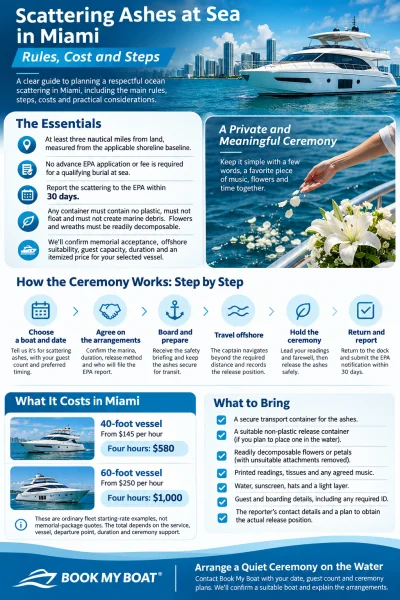
Key Takeaways
Ocean scattering under the EPA general permit must take place at least three nautical miles from land, measured from the applicable shoreline baseline.
No advance EPA application or EPA fee is required for a qualifying burial at sea.
The scattering must be reported to the EPA within 30 days; agree beforehand who will submit it.
Any container released into the ocean must contain no plastic, must not float and must not create marine debris. Flowers and wreaths must be readily decomposable.
We’ll confirm memorial acceptance, offshore suitability, guest capacity, duration and the itemized price for your selected vessel before booking.
Is It Legal to Scatter Ashes at Sea in Florida?
Yes. Cremated human remains may be scattered in ocean waters off Florida under the EPA’s general permit, at least three nautical miles from land. No advance EPA application is required, but the burial must be reported within 30 days. Separate rules can apply to transport and inland-water scattering.
The EPA burial at sea guidance explains the federal requirements. This article concerns cremated human remains; full-body burial has additional requirements and needs different arrangements.
The ocean permit does not authorize scattering inside Biscayne Bay. Rivers, lakes and inland bays fall under a different regulatory framework, and state or local requirements may apply. A beach departure also does not make shoreline scattering permissible under the ocean permit. The vessel must reach a compliant offshore location before the ashes are released.
For families researching laws on scattering ashes at sea in Florida, the main distinction is where the release happens. A scenic bay cruise and an offshore memorial are different trips. We’ll confirm that the proposed charter can reach the required location, rather than treat a regular sightseeing route as suitable automatically.
The EPA Rules in Plain English
The federal general permit appears in 40 CFR 229.1. For a cremated-remains ceremony, the practical requirements focus on the release location, materials entering the water and post-release reporting.
These requirements should shape the booking from the beginning. The captain needs an appropriate offshore route, the family needs suitable materials, and someone needs responsibility for the notification. A funeral director can help with transport arrangements and documents when needed. General guidance does not replace requirements that apply to your particular circumstances.
How Far Is Three Nautical Miles Off Miami?
Three nautical miles is approximately 3.5 statute miles. The measurement uses the applicable coastal baseline: the ordinary low-water mark or a closing line shown on nautical charts across the opening of a bay or river.
It is not simply three nautical miles from the departure dock. For example, leaving from a marina on the Miami River may require travel through inland waterways before reaching the offshore area. The captain identifies a compliant release position using the relevant chart boundary.
We’ll confirm the departure marina and whether the vessel and captain can accommodate that passage. Your total charter time needs to cover boarding, the journey out, the ceremony, the return and disembarkation. Cremated remains do not have the minimum water-depth requirements that apply to non-cremated remains under this permit. The three-nautical-mile location requirement still applies.
Containers and What You Can Release
You may pour the ashes directly into the ocean or release them in a suitable container. If the container enters the water, it must contain no plastic, must not float and must not contribute to marine debris. EPA guidance says it should ideally degrade or dissolve within a relatively short time.
A container used only to transport ashes can remain aboard after the ashes are poured. The ocean-disposal rules do not require discarding or replacing every storage urn. Keep a decorative, metal or plastic transport urn on the boat; use an appropriate release method rather than putting it into the sea.
For materials accompanying the ashes:
Use flowers and wreaths made entirely from readily decomposable materials.
Remove plastic wrapping, ribbons, wire frames and other unsuitable attachments.
Keep packaging, photographs, cards and personal objects aboard.
Do not release balloons or use unrecovered rockets or similar devices to carry ashes.
Do not include pet remains, whether separately or mixed with human ashes.
“Biodegradable” on a product label is not enough to establish that every component is suitable for ocean release. Check the construction, including bindings and decorations. We’ll discuss your planned materials before the charter so the ceremony does not depend on an item that cannot enter the water.
Reporting to the EPA Within 30 Days
The burial must be reported to the EPA Region from which the vessel departed. The Burial at Sea Reporting Tool provides an online way to submit the notification. EPA guidance says a death certificate does not need to accompany this report.
Agree on who will file it before the charter. That may be a family member, funeral director or service provider, depending on the arrangement. Booking a boat does not establish that reporting is included.
The reporting process is straightforward:
Open the reporting tool and choose the applicable individual-report option. Follow its current sign-in or guest-submission instructions.
Enter the requested contact information for the person responsible and details about the vessel.
Supply the deceased’s information, the date of burial, departure location and type of remains.
Enter the release location and other requested distance information. Use the captain’s recorded position rather than an estimated point based on the marina.
Review the information, submit the notification and retain the confirmation supplied by the system.
Keep the filing deadline with the charter details. If another person submits the report, arrange to receive a copy or confirmation. If the online system is unavailable or you need clarification, the EPA guidance provides regional contacts for reporting by other means.
Keeping a Record of the Scattering Location
Before departure, agree who will record the date and release position and who will keep the reporting confirmation. Recording the time is also useful for the family’s own notes. Make sure the person filing the notification receives the actual location after the ceremony.
If coordinates are recorded in one format and the reporting tool asks for another, use an accurate conversion rather than changing the numbers by guesswork. Family keepsakes are separate from required reporting. A photograph, video, written remembrance or record of the coordinates may be meaningful, but none should be assumed to come with a standard charter. We’ll confirm any available support beforehand. Obtain guests’ consent before recording a private ceremony, and decide who may receive or share the files.
A record of the location does not reserve that part of the ocean or guarantee access to the same position on a future trip.
How a Ceremony Works on a Yacht, Step by Step
There is no required format for a family’s readings, music or silence. The charter needs a workable route and safe release plan, while the ceremony can reflect your loved one’s wishes.
Choose a boat and date. Tell us that the booking is for scattering ashes, with your expected guest count and preferred timing. We’ll confirm memorial acceptance and offshore suitability before you reserve.
Agree on the arrangements. Confirm the marina, boarding time, charter duration, release method, and any requested assistance. Identify who brings the ashes, leads the ceremony, and files the EPA report.
Board and receive the safety briefing. Keep the ashes secure for transit and bring readings or flowers in manageable containers. Guests should follow the crew’s instructions about seating and movement.
Travel to a compliant ocean location. The captain navigates beyond the required baseline distance, assesses conditions, and records the release position.
Hold the ceremony and release the ashes. The captain determines a safe vessel position and release area. Your chosen family member or officiant leads the readings and farewell.
Return and complete the notification. The boat returns to the agreed dock. The designated reporter collects the location details and submits the EPA notification within 30 days.
Share any sequence you care about before departure. A family might want music before the release, individual flowers afterward, and quiet time on the return. Wind direction matters when pouring ashes. The captain can position the boat and identify an appropriate side for release so ashes are carried away from guests. Remain within the approved area and avoid leaning over rails. If conditions make your intended method unsuitable, the crew’s safety instructions take priority.
Private Yacht or Specialist Service: Which Fits?
For burial at sea in Miami, the choice is often between an unattended specialist service, an attended memorial package, and a private boat charter. They offer different levels of involvement and should be compared on more than price.
Arrangement | Family attendance | Planning and support to confirm | Privacy and guest considerations |
|---|---|---|---|
Unattended specialist service | Family does not travel aboard | Receipt of remains, authorization, release, reporting and any keepsakes | Confirm whether the service is individual or part of a scheduled voyage |
Attended memorial service | Family attends | Ceremony assistance, reporting, release materials and onboard support | Confirm whether the boat is private or shared and its permitted capacity |
Private yacht charter | Your invited group attends | Boat, captain, route and any separately agreed ceremony assistance | Your group has the booked vessel; capacity and access remain vessel-specific |
A private charter can suit a family that wants to lead its own farewell. It does not automatically include a funeral professional, urn, officiant, memorial certificate or filing service. We’ll confirm the scope of support available for the selected booking.
Our guides to boat rental with a captain and what a charter price includes explain the boat-service side of the arrangements.
Arranging an Unattended Scattering Service
An unattended service requires specific arrangements for receiving, identifying and releasing the remains. Do not assume that a standard yacht rental offers it. We can confirm whether an appropriate arrangement is available before any remains are delivered.
For a specialist service, establish who authorizes the scattering, how the remains are identified, when the voyage is scheduled and who handles EPA notification. Get the delivery instructions in writing, including the recipient and required packaging or documents.
If shipping is involved, confirm the carrier’s current cremated-remains rules directly. Do not use an ordinary parcel service without checking that it accepts the contents and shipment. A funeral director can help you arrange appropriate transport.
Also confirm what you receive afterward. Coordinates, photographs, video and a memorial certificate may be included, optional or unavailable. Ask how weather changes the date and when any promised records will be provided. That written scope is especially useful when no family member will be present aboard.
What It Costs in Miami
The price depends on the service type, vessel, departure point, duration and support involved. An unattended specialist service and a private charter are different purchases; a lower figure may cover a release without family attendance rather than a boat reserved for your group.
For a Book My Boat memorial charter, contact us with your date, guest count and preferred ceremony arrangements. We’ll confirm suitable options and an itemized quote. Ordinary fleet prices help illustrate the boat budget, but they are not approved memorial packages.
Option | Price information | What needs confirmation |
|---|---|---|
Unattended specialist service | Request a current service-specific quote | Receipt of remains, release schedule, reporting and keepsakes |
Attended memorial service | Request a current package quote | Private or shared boat, permitted guests, ceremony support and reporting |
Smaller private-charter example | Our cost guide lists a 40-foot vessel from $145 per hour; four hours calculates to $580 | Memorial acceptance, offshore route, actual duration and final charges |
Mid-size private-charter example | Our cost guide lists a 60-foot vessel from $250 per hour; four hours calculates to $1,000 | Same checks, plus layout and assistance needed by your guests |
The private-charter illustrations come from our Miami yacht rental cost guide. These are starting-rate calculations, not live offers or guarantees that these vessels accept memorials. A boat’s length alone doesn't mean it suits the trip.
Your quote should identify the vessel rental, captain and crew arrangements, fuel for the proposed offshore route, dockage, applicable taxes and other booking charges. Confirm whether flowers, a release container, officiant, photography or reporting help are included or separately arranged. Add a charge only if it is excluded from the quote.
Gratuity treatment also needs confirmation. We’ll explain whether it is included, separately charged or left to your discretion for that booking. Keep any optional allowance separate when comparing totals so it is not counted twice.
Contact us about a memorial charter with the number of guests and any accessibility needs. We can help you compare the full arrangements before you commit.
Planning the Day: Guests, Timing and Weather
Guest Count and Vessel Capacity
Begin with everyone who needs to be aboard, including children and any officiant or photographer. Approved passenger capacity and the charter arrangement determine the permitted group, rather than yacht length alone. Our guide to what size yacht you need explains the planning considerations.
Some listings show 13 guests, but that is not a universal rule for all charters. We’ll confirm the specific vessel’s permitted count and how any additional personnel are counted. A child who is not contributing to the cost still belongs on the guest list.
Accessibility and Comfort
For older guests or anyone with limited mobility, share practical needs before choosing a vessel. Boarding may involve a gangway, steps, uneven surfaces or movement between the dock and boat. We’ll confirm available access, seating, shade and bathroom arrangements rather than assume a larger yacht is accessible.
Anyone concerned about seasickness can discuss suitable options and medication timing with a healthcare professional or pharmacist. Offshore conditions may differ from sheltered bay conditions. A seat in shade, drinking water and a manageable schedule can help with comfort, but no charter can promise calm seas.
Children and Pets at the Ceremony
For children, send us their weights so we can confirm appropriate life-jacket sizes and vessel rules. Arrange adult supervision throughout the trip. If a living pet will attend, request approval before booking; this is separate from the rule excluding pet ashes from the ocean burial permit.
Ceremony Timing and Offshore Travel
Sunrise and sunset may appeal to your family, but travel time determines whether the ceremony can actually happen at that hour. Share the preferred ceremony time, not just the desired departure time. Our best time to rent a boat in Miami guide offers seasonal context without guaranteeing conditions.
Weather Decisions and Rescheduling
The licensed captain has final, binding authority on safe operation. If the captain determines before departure that conditions are unsafe, we work with you and the vessel owner to reschedule or refund the vessel rental amount. Refunds of third-party operational fees follow the applicable independent provider’s policies.
Temporary weather may instead lead to a delayed departure, different route or adjusted itinerary. Those operational adjustments are not cancellations and do not entitle the customer to a refund. We do not guarantee sunshine, calm seas, visibility or any specific weather conditions.
Customer Cancellations and Separate Fees
If the captain determines the trip can safely proceed but you choose not to participate because of personal weather concerns, the standard customer-cancellation policy applies. The vessel rental price is refundable with at least 24 hours’ notice unless the booking confirmation expressly states a different policy; within 24 hours it is non-refundable. Captain, crew, fuel and other third-party operational fees are earned and committed upon confirmation and are non-refundable unless the applicable provider authorizes a refund in writing.
Our weather and cancellation guide explains these distinctions. The Terms of Use also address disruptions beyond our reasonable control, including severe weather and marina closures.
What to Bring and Which Documents to Have
Keep the packing list practical. Secure the ashes for the journey, protect paper readings from spray and keep loose materials contained until the ceremony. There is no need to bring elaborate decorations to create a meaningful farewell.
Use this pre-ceremony checklist:
A secure transport container for the ashes, retained aboard if unsuitable for ocean release.
A suitable non-plastic release container, if you plan to place one in the water.
Readily decomposable flowers or petals, with unsuitable attachments removed.
Printed readings, tissues and any agreed music playback arrangements.
Water, sunscreen, hats and a light layer.
Guest and boarding details, including any required identification.
Any transport or vessel-specific documents confirmed for your arrangements.
The reporter’s contact details and a plan to obtain the actual release position.
EPA notification does not require submission of a death certificate. That does not settle every document requirement for transporting ashes or boarding a particular charter. We’ll confirm vessel requirements, while your funeral home can help with transport documentation.
Keep documents dry and accessible. Decide which family member is responsible for the ashes during arrival and boarding, especially if several people are helping. On the return, retain the transport container and all packaging rather than leaving disposal arrangements uncertain.
Ceremony Ideas and Readings
A short ceremony can leave space for quiet without asking anyone to speak before they are ready. One person can lead, while others contribute a reading, flower, or private thought. Participation does not have to be the same for every guest.
You might choose:
A welcome and a brief explanation of the sequence.
A favorite poem, passage or personal memory.
Music played softly where the vessel’s equipment allows.
A moment of silence before releasing the ashes.
Permitted flowers released afterward.
A remembrance toast; alcoholic drinks are for guests 21 and older where permitted.
Share requests for quieter engines or music before booking. The captain decides what is operationally safe at the release location, so engine shutdown cannot be promised. A simple backup, such as printed words instead of amplified sound, keeps the ceremony manageable if equipment or conditions differ.
Agree on a photograph policy with the family. Some guests may want a record, while others prefer privacy. A picture of the sea or flowers can serve as a keepsake without recording someone’s most difficult moment.
Choosing a Boat and Captain
Tell us that you are arranging an ash scattering boat charter in Miami before selecting a standard package. We’ll confirm whether the owner and captain accept a memorial and whether the vessel, route and booked duration suit it.
Useful details include the guest count, preferred date, mobility needs, release method and any requested ceremony support. Our step-by-step rental guide explains the wider booking process.
Before payment, establish the scope of the booking: offshore passage, approved capacity, included charges, cancellation terms, location recording and who submits the report. If you need an officiant, reporting assistance or keepsakes, include those requests early. They are separate services rather than assumed parts of every yacht rental.
Frequently Asked Questions
Is it legal to scatter ashes at sea in Florida?
Yes. Cremated human remains may be released in ocean waters at least three nautical miles from the applicable coastal baseline under the EPA general permit. No advance EPA application is needed, but notification is required within 30 days. This ocean authorization does not cover scattering inside Biscayne Bay or other inland waters.
Do I need a permit to scatter ashes at sea?
A qualifying ocean burial uses the EPA’s general permit, so no advance EPA application or fee is required. You must still comply with its location and material requirements and report the scattering within 30 days. Transport, vessel arrangements or unusual circumstances may involve separate requirements; the general permit does not resolve every aspect of the trip.
Can you put flowers or a wreath in the ocean?
Yes, if all materials are readily decomposable in the marine environment. Remove plastic wrapping, synthetic ribbons, wire and other unsuitable components before release. Don't assume a wreath is suitable simply because it contains real flowers. Keep packaging aboard and share your planned materials with us before the charter so we can confirm the arrangements.
What kind of urn can be used?
A container released into the ocean must contain no plastic, must not float and must not create marine debris; EPA guidance favors one that degrades or dissolves relatively quickly. You can also pour ashes directly and keep the transport urn aboard. There is no EPA urn-certification requirement stated in the guidance used for this article.
How much does it cost to scatter ashes at sea in Miami?
The total depends on the service, vessel, departure point, duration and ceremony support. Our ordinary fleet starting-rate examples calculate to $580 or $1,000 for four hours, but these are not memorial-package quotes. Contact us with your guest count and requirements so we can confirm an appropriate vessel, offshore route and itemized price.
Can you scatter ashes on the beach in Florida?
The ocean general permit does not authorize releasing ashes into nearshore water from a beach; ocean scattering must meet the three-nautical-mile requirement. Scattering on land involves separate permission and rules. Contact the relevant landowner or city, county or state authority before planning a beach ceremony. A beach visit without scattering can be a separate remembrance.
Can pet ashes be scattered with human ashes?
No. The EPA general permit authorizes burial at sea of human remains only. Pet ashes cannot be released under that permit, either separately or mixed with human ashes. Bringing a living pet aboard is a different matter and requires approval for the selected vessel before booking. Keep those two arrangements separate when planning the memorial.
Arrange a Quiet Ceremony on the Water
When you are ready, contact Book My Boat with your date, guest count and ceremony plans. We’ll confirm whether a suitable boat can accommodate the memorial and explain the arrangements before you reserve. You can also browse our fleet to explore vessel options.