

Boat Rental Agreement Miami: Deposits, Insurance, Liability
Mariam Revuelta
Before you sign for a charter, three questions deserve clear answers: what do you owe, who is responsible if something gets damaged, and what money can you get back?
At Book My Boat, we help you understand the payment terms, deposits and responsibilities attached to your booking. Your confirmation and the applicable agreement explain the details for your selected vessel. A captained charter also differs from a rental where you operate the boat yourself, particularly when it comes to boating credentials and insurance.
Key Takeaways
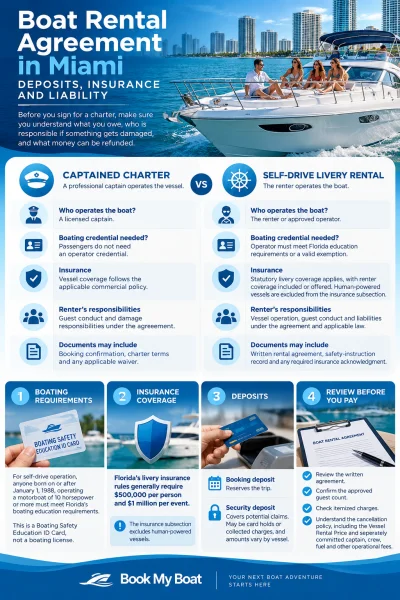
On a captained charter, the captain operates the vessel. A self-drive rental gives the renter additional operating responsibilities.
Florida's livery insurance rules generally require $500,000 per person and $1 million per event. The insurance subsection excludes human-powered vessels.
A booking deposit reserves the trip; a security deposit covers potential claims. Security deposits may be card holds or collected charges, and amounts vary by vessel.
Our cancellation policy distinguishes the Vessel Rental Price from separately committed captain, crew, fuel and other operational fees.
Review the written agreement, approved guest count and itemized charges before paying. Contact us if you need help understanding a booking detail.
Captained Charter vs Livery Rental: Who Is Responsible
A captained charter puts navigation and vessel operation in the hands of a licensed captain. On a self-drive rental, the renter operates the boat and must meet the applicable education and rental requirements.
Florida's livery statute distinguishes a livery from an arrangement that provides or requires a USCG-licensed master to operate or manage the vessel. The current statute includes that distinction; not every paid boat booking is a livery rental.
Question | Captained charter | Self-drive livery rental |
|---|---|---|
Who operates the boat? | A licensed captain | The renter or approved operator |
What boating credential does the guest need? | A passenger does not need an operator credential | The operator must satisfy Florida education requirements or a valid exemption |
How is insurance handled? | Vessel coverage follows the applicable commercial policy | Statutory livery coverage applies, with renter coverage included or offered; human-powered vessels are excluded from the insurance subsection |
What responsibilities remain with the renter? | Guest conduct and damage responsibilities under the agreement | Vessel operation, guest conduct and liabilities under the agreement and applicable law |
What documents may apply? | Booking confirmation, charter terms and any applicable waiver | Written rental agreement, safety-instruction record and any required insurance acknowledgment |
Our captain guide and boat rental versus yacht charter guide explain the booking options. We help clarify which arrangement applies to your selected vessel.
What Do You Need to Rent or Operate a Boat in Miami?
The person signing or paying may be different from the person operating the boat. Minimum renter age, identification, payment authorization and attendance requirements belong in the booking details. We help you review these before confirmation, including whether the named renter must be aboard.
A passenger on a captained charter does not need a boating operator credential. For self-drive operation, Florida generally requires anyone born on or after January 1, 1988, operating a motorboat of 10 horsepower or more to meet its boating education requirements. This is a Boating Safety Education ID Card, not a boating license.
The education statute explains the requirement, while the FWC education FAQs describe accepted proof and exemptions. Qualifying out-of-state education documents may be accepted with photo identification. Approved temporary certificates are valid for 90 days and require photo ID.
Exemptions include certain USCG credential holders and operators accompanied by a qualifying adult who is responsible for safe operation. An exemption does not replace the rental company's own eligibility requirements or the pre-rental safety instruction required for a livery.
What a Miami Boat or Yacht Rental Agreement Usually Contains
A Miami yacht rental agreement should identify the vessel, the people involved and the terms of the trip. Read the confirmation alongside any additional documents so the price, schedule and responsibilities agree.
Clause | What to look for |
|---|---|
Parties and vessel | The contracting parties and the specific boat being booked |
Term and hours | Departure and return dates, times, locations and booked duration |
Fees and payment schedule | Included services, separate charges, booking payment and balance deadlines |
Deposit | Whether a security deposit applies, how it is collected and its release conditions |
Cancellation | Notice deadline, confirmation-specific terms and separate operational-fee rules |
Passenger limit | The approved guest count for the vessel and charter arrangement |
Conduct rules | Applicable restrictions on alcohol, smoking, pets, glass and onboard activities |
Fuel | Included cruising allowance and how additional fuel is priced |
Damage | Responsibility, reporting requirements, evidence and any claim procedure |
See the terms on any listing before you book. We can help explain how the listed inclusions relate to your confirmation.
For an overnight booking, the agreement also needs to reflect accommodation and handover arrangements; our overnight charter guide explains those planning considerations.
Late Returns and Unapproved Extensions
Your booked hours include an agreed return time and location. Arriving late for boarding does not automatically move the end of the trip, and staying out longer requires approval. Any grace period, overtime rate and billing increment should be stated in the applicable agreement.
Contact our team promptly if your plans change so we can help coordinate an extension with the vessel's provider. Keep written confirmation of the revised time and cost.
Security Deposits: Hold, Charge and Release
A booking deposit is a payment toward your reservation. A security deposit is a separate amount reserved or collected against potential losses covered by the agreement. Paying one does not necessarily mean you have paid the other.
With an authorization hold, money is reserved against your card's available balance without being collected as a completed charge. With a collected deposit, the payment is taken and an eligible refund is processed later.
There is no single standard security-deposit amount for Miami boat rentals. Some vessels may require none; others set an amount and collection method for the booking. Contact Book My Boat for the requirements attached to your selected boat, including when the hold or charge occurs and who handles release.
Release depends on the agreement, any applicable claim and banking processing.
A deposit is not automatically a limit on liability. The agreement may make you responsible for qualifying losses above the deposit, while ordinary wear, existing damage and disputed charges require consideration under the relevant terms.
Insurance: What Is Covered and What Is Not
Vessel insurance and protection for your personal expenses are different. Commercial coverage on a captained charter follows the actual policy, including its insured parties, exclusions, limits and deductibles. The presence of insurance does not establish that every guest expense or damage claim is covered.
Review these areas separately:
Personal belongings: loss or damage to phones, bags and other possessions may require separate personal coverage.
Medical expenses: vessel insurance should not be treated as a substitute for your own health or travel cover.
Cancellation expenses: an ordinary vessel policy does not establish your right to recover a canceled trip's cost.
Damage deposits: a retained deposit is not automatically reimbursed by insurance; that depends on any applicable cover and the claim.
For self-drive liveries, section 327.54 requires coverage of at least $500,000 per person and $1 million per event. The livery must also insure the renter in the prescribed manner or offer qualifying coverage for purchase. Declining the offered coverage requires a signed acknowledgment of possible personal liability. This insurance subsection does not apply to human-powered vessels.
Contact us for the insurance information associated with your booking. Your insurer can determine whether a personal policy covers your specific activity. For company bookings requiring documentation, our corporate charter guide explains certificates of insurance and related paperwork.
Damage, Fuel and Dock Costs: Who Pays
Damage responsibility depends on the agreement, the cause of the loss and any applicable insurance. If you or your guests cause damage, the rental terms may make you financially responsible.
Scenario | How the cost is handled |
|---|---|
Damage caused by a guest | Assessed under the damage terms and applicable coverage |
Existing damage | Record before departure so it is distinguishable from a new issue |
Standard-route fuel | Included or billed separately as stated in the proposal |
Extra cruising or a longer route | Any additional charge needs to follow the agreed fuel terms |
Captain and crew | Show included services and separately collected fees clearly |
Additional dock stops, cleaning or missing equipment | Apply the booking's specific charges and responsibility rules |
Our what's included guide helps you compare packages. The Miami yacht rental cost guide explains the wider pricing factors.
How Should You Document the Boat Before Departure?
Take dated photos or video of accessible areas before departure, or participate in a provider-led condition record. Include existing marks, damaged fittings and relevant equipment without interrupting the safety briefing or entering restricted crew areas.
Report a discrepancy before leaving the dock and contact our team in writing so there is a record. Where possible, obtain written acknowledgment that the issue existed before your trip.
At return, follow the inspection arrangements in the agreement. Retain your photos, messages and any inspection record. If a charge is proposed, the relevant terms should explain the evidence and review process.
Cancellation and Payment Terms
Our Cancellation and Refund Policy distinguishes the Vessel Rental Price from third-party operational fees. The standard customer cancellation window is 24 hours before scheduled departure, unless your confirmation expressly states a different policy.
Situation | What happens |
|---|---|
You cancel at least 24 hours before departure | The Vessel Rental Price is fully refundable unless the confirmation expressly states a different cancellation policy |
You cancel less than 24 hours before departure | The Vessel Rental Price is non-refundable, subject to the confirmation's stated policy |
Captain, crew, fuel and other third-party operational fees | Separate from the vessel price, collected solely as payment facilitator, earned and committed upon confirmation, and non-refundable unless the applicable provider expressly authorizes a refund in writing |
The owner or Book My Boat cancels for vessel unavailability or circumstances within our control | A comparable replacement vessel, rescheduling or a full refund of amounts paid for the vessel rental |
An approved refund is processed | It returns to the original payment method; processing time depends on the financial institution |
The policy acknowledges that cancellation alone is not grounds to dispute committed operational fees through a chargeback. That statement concerns the specified cancellation situation; it should not be read as a blanket prohibition on every payment dispute.
Bank or payment-processor delays can affect approved refunds, for which Book My Boat disclaims responsibility. The policy does not specify a fixed refund-processing deadline or promise reimbursement of every operational fee following an owner cancellation.
Booking payments, balance deadlines and security-deposit release terms are separate from this cancellation policy. Keep the scheduled departure time and your written cancellation record together when calculating notice. Our weather policy guide explains weather-related considerations; a forecast alone does not establish a refund entitlement.
How a Marketplace Agreement Differs From a Broker or Owner Contract
A marketplace booking can involve documents from more than one party. The agreement should identify who provides the vessel, who supplies operational services and who receives each payment. These roles matter when you need to change a booking or understand a charge.
Under our cancellation policy, Book My Boat acts solely as payment facilitator for captain, crew, fuel and other third-party operational fees.
The confirmation may expressly specify a different customer-cancellation policy. Read it with the remaining terms covering contracting parties, payment deadlines, insurance and liability. Contact us to review the agreement for your selected boat before payment.
For a longer stay, operating allowances, overnight capacity and itinerary changes add further details. Our weekly charter guide explains the costs and planning involved.
Pre-Signing Checklist and Red Flags
Before you confirm a Miami yacht charter contract, review these eight items:
The captain's applicable credentials and vessel insurance information.
Booking payments versus any separate security deposit.
The cancellation policy expressly stated in the confirmation.
Itemized operational fees and the provider's refund-authorization rules.
The approved passenger count for your charter.
Fuel inclusions and additional-cruising charges.
Damage reporting, condition records and inspection procedures.
Your booking and departure-day support contacts.
Missing written terms or unclear payment and refund responsibilities deserve clarification before payment.
Frequently Asked Questions
What is in a boat rental agreement in Miami?
A boat rental agreement identifies the parties, vessel, booking period, charges, deposits, cancellation terms, passenger limit and onboard rules. It should also explain fuel costs and damage responsibilities. Your confirmation and any additional provider documents work together to describe the booking. We help clarify how those terms apply to your selected boat before payment.
Can someone else sign the rental agreement for my group?
Possibly, depending on the contract and payment requirements. The named renter, authorized payer and passengers may have different roles, and some bookings require the signer to attend. Contact Book My Boat with your group's arrangements so we can review the applicable requirements before confirmation. Paying for someone else's trip does not automatically authorize you to sign every document.
How much is the security deposit for a boat rental in Miami?
The amount varies by vessel, and some bookings may require no security deposit. There is no standard Miami amount that applies to every charter. Contact us for your boat's requirements, including whether the deposit is a card hold or collected charge, when it is taken and what conditions govern its release or refund.
Who is liable if I damage a rental boat?
You may be financially responsible for damage you or your guests cause, depending on the agreement and applicable coverage. A self-drive operator also has operating responsibilities. Florida's livery statute requires renter coverage to be included or offered in applicable cases; declining offered coverage requires acknowledgment of possible personal liability. A captain's presence does not remove every guest responsibility.
Do I need insurance to rent a boat in Florida?
It depends on the arrangement and the protection you need. Applicable liveries must carry statutory coverage and either insure the renter or offer qualifying coverage for purchase. Declining offered coverage requires a signed acknowledgment; human-powered vessels are excluded from that insurance subsection. For a captained charter, review the vessel policy separately from personal belongings, medical and cancellation protection.
Do I get my security deposit back?
A refundable security deposit is normally released or returned when the agreement's conditions are met and no valid deduction applies. The collection method, inspection process and banking times affect when funds become available. Contact us for the terms attached to your booking, and retain any release confirmation alongside your receipt and condition records.
Book With the Terms in Front of You
Browse yachts on Book My Boat, review the listed terms, and contact our team for help with your selected vessel's agreement. We will help you understand the payment details and booking requirements before you confirm. Our step-by-step rental guide explains how to prepare for departure.