
Corporate Yacht Charter: COI, W-9 and Net 30 Terms
Mariam Revuelta
The event is approved and everyone's looking forward to it. Then procurement asks for a certificate of insurance, a W-9, and Net 30 terms, and the whole thing stalls. Good news: all three are standard here and none of them need to slow you down. Here's what to send, when to send it, and how long each step really takes.
Disclosure: Book My Boat is a Miami yacht booking platform. We sell charters on boats owned by independent owners and earn a margin on each booking. Figures marked as ours describe our own records, not the whole market.
Key Takeaways
Three documents clear most approvals: a COI, a W-9 and a signed services agreement.
A COI goes out with every quote, and a W-9 is on file for vendor setup.
Net 30 invoicing is available with a signed contract.
ACH, wire and corporate card are all accepted, which gives AP three routes.
Six to twelve weeks for standard dates. Three to six months for multi-boat events.
What Procurement Asks For
The standard vendor packet is short. A W-9, a certificate of insurance, a signed services agreement, and a completed vendor registration form. Request all four at the quote stage and nothing waits on paperwork later.
The Certificate of Insurance
A COI is a one-page summary of the operator's coverage, issued on the ACORD 25 form. It names the insurer, the policy numbers, the coverage types, and the limits, plus the dates the policy runs.
A COI is sent with every quote here, which removes the most common source of delay. What your risk team may want on top is an additional-insured endorsement naming your company. That's a specific request, so raise it early rather than assuming a standard COI covers it.
Check the dates cover your charter date, not just today. A policy expiring the week before your event fails review even when everything else is right.
The W-9 and Vendor Setup
Your accounts payable system needs the operator's taxpayer information before it can issue any payment. That's what the W-9 provides, and one is held on file, ready to send.
Vendor setup in a typical AP system takes three to ten business days once the form lands. Larger companies run longer. Start it the day the quote is approved rather than the week of the event, because this step blocks everything downstream. The IRS's own instructions for Form W-9 explain what each field means if your finance team asks.
Net 30 and Payment Terms
Here's the conflict that decides whether corporate bookings happen at all. Charter operators normally want a deposit up front and the balance before sailing. Corporate AP pays thirty days after invoice. Both positions are reasonable and they point in opposite directions.
Three resolutions work. A corporate card settles it immediately and is the fastest route. A deposit now with the balance on Net 30 splits the difference. A purchase order issued before the charter gives AP the reference it needs to pay afterwards.
Net 30 invoicing is available here with a signed contract, so the second and third options are both live. The corporate card remains the quickest when the date is close.
Corporate Cards, ACH, Wire Transfers and Purchase Orders
Your payment method shapes your timeline more than people expect, so pick it early.
Corporate card. Fastest by a distance. No vendor setup wait, and the booking confirms the same day.
ACH. Standard for AP departments. Needs vendor setup completed first, then two to three days to clear.
Wire transfer. Useful for larger amounts and same-day settlement, though it usually needs a second approval internally.
Purchase order. Not a payment method, but often the gate. Some AP systems won't process an invoice without a PO number issued beforehand.
ACH, wire, and card are all accepted, and Net 30 is available with a signed contract. Ask your finance team one question at the start: does this need a PO, and who raises it. That single answer prevents the most common two-week delay.
The Services Agreement
Your legal team will read for six things. Here's what each one covers and what a reasonable version looks like.
Indemnification. Who covers what if a guest is injured or property is damaged. Mutual indemnity is the common shape.
Limitation of liability. Usually capped at the charter fee. Companies sometimes ask for a higher cap on larger events.
Cancellation. The deadline, the refund schedule and what happens to the deposit.
Force majeure and weather. Who calls it, when, and what remedy follows.
Guest conduct. What the operator can do if a guest creates a safety issue.
Alcohol service. Whether it's served by crew or brought aboard, and who holds responsibility.
None of that is unusual for an event vendor contract. Send it to legal at the same time as the COI and both reviews run in parallel rather than one after the other.
Confidentiality and Crew Requirements
Board retreats, executive offsites, and unannounced product launches all raise a question the standard packet doesn't answer. Who else is aboard, and what are they allowed to repeat?
Crew NDAs are available on request, and NDA-trained captains can be assigned. Crews are background-checked as standard. Higher-clearance NDAs go through a compliance review, which takes time, so flag it at quote stage rather than the week before.
Raise confidentiality during procurement so it gets documented alongside everything else. An NDA agreed by email two days out is worth much less than one attached to the signed services agreement.
A Realistic Procurement Timeline
Step | Who owns it | Typical duration |
|---|---|---|
Quote requested, COI issued with it | You and the operator | 1 to 2 days |
W-9 sent, vendor setup opened | Your AP team | 3 to 10 business days |
Services agreement legal review | Your legal team | 5 to 10 business days |
NDA or compliance review, if needed | Both | 5 to 15 business days |
Purchase order issued | Your finance team | 2 to 5 business days |
Deposit paid, date confirmed | You | Same day |
Final headcount and catering confirmed | You | 7 to 10 days before the charter date |
Invoice issued, Net 30 begins | Operator | After the event |
Steps two, three, and four run in parallel if you start them together. Run them in sequence and a six-week lead time becomes ten.
What a Corporate Charter Costs
A single yacht carries 12 to 49 guests depending on its certification. Passenger vessels go up to 375, and a fleet booking across several boats handles 200 to 500 or more.
Pricing follows the same size bands as any charter, from about $700 an hour on a 60 ft to $3,000 on a 98 ft carrying 49 guests. The corporate premium comes from four things: weekday availability, catering at scale, AV and branding, and additional staffing. Our full pricing guide has the size-by-size breakdown. You can see current boats, prices and marinas on our Miami yacht charter page.
Event Types That Work on the Water
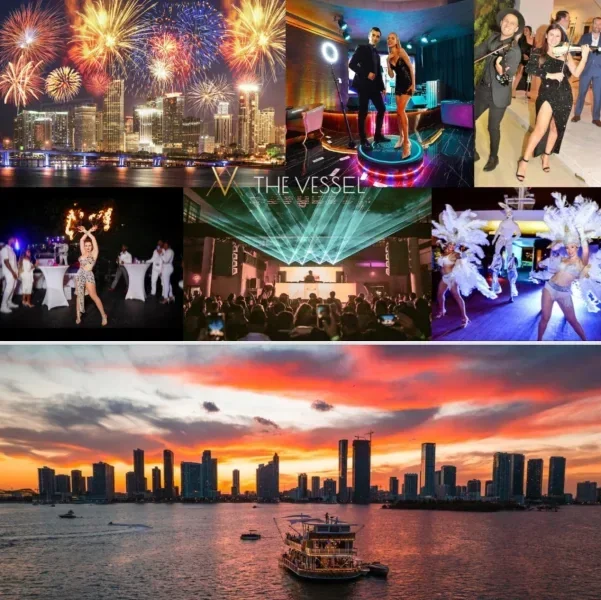
Client entertainment is the easiest win. Eight to twenty guests, three to four hours, sunset timing, and the boat does the work a restaurant can't.
Team offsites run longer, usually a full day with a sandbar stop or a scavenger hunt built in. Product launches need a docked vessel for AV and guest flow. Board meetings want a smaller boat, a table, and the NDA conversation handled up front.
Holiday parties are the one to book earliest. December is busy in the office, and the evenings around Art Basel and the holidays go early on the water.
Branding and AV on Board
More is possible than people assume. Wireless microphone systems are available on larger yachts, along with screen and projector setups and Bluetooth or HDMI connectivity. Branded yacht wraps need four to six weeks of lead time, and custom bow signage or backdrops are straightforward.
The real constraint is motion and wind rather than equipment. A presentation works far better at the dock, where power is stable, sound behaves, and nobody's squinting into the sun. A docked vessel also carries more guests, which our guide to booking for larger groups explains in detail.
Is a Corporate Charter Deductible?
This one needs care rather than a confident answer. Current federal rules generally disallow deductions for entertainment expenses, while certain business meal expenses may remain partly deductible under specific conditions.
How a charter is characterized depends on the purpose of the event, who attends, and what documentation you keep. IRS Publication 463 is the primary reference and sets out the current treatment.
Confirm the treatment with your own accountant before you assume anything. Nothing here is tax advice, and the answer genuinely varies by how the event is structured.
What We See in Corporate Requests
Corporate events are a small share of our bookings: 1.5% of the customer conversations we analyzed from May to November 2026. They are also the ones that ask for paperwork before price. In those conversations, 37.1% of all customers asked about deposits and payments, and several did not want to pay through a link without a contract or receipt first. For a company, that is normal procurement: ask for the agreement, the certificate of insurance and the W-9 before any deposit.
Season matters for availability more than for price: About 75% of our charter activity falls between March and August; July 2026 was the record month, with about 476 completed charters across both channels, and November to January is the quietest period.
Frequently Asked Questions
Can a company get a contract before paying the deposit?
Yes, ask for it. Request the services agreement, the certificate of insurance and the W-9, and pay only once procurement has approved them.
What insurance limits do most companies require?
Requirements vary by company risk policy, and larger organizations set higher thresholds. A COI is issued with every quote showing the operator's current coverage and limits, backed by Coast Guard passenger vessel requirements for the underlying vessel certification. If your team needs an additional-insured endorsement naming your company, request it at quote stage so it can be issued in time.
Can we book on Net 30 terms?
Yes, with a signed contract. Three routes work in practice: a corporate card for speed, a deposit now with the balance on Net 30, or a purchase order issued before the charter. The corporate card is fastest when your date is close and vendor setup hasn't started.
How far in advance should a company book?
Six to twelve weeks for a standard corporate date. Three to six months for multi-boat fleets or product launches, and six to nine months for major weeks. Those windows include procurement, not just vessel availability, which is what most planners underestimate.
Can we book multiple boats for one event?
Yes. Fleet bookings handle 200 to 500 or more guests across several vessels, with captains coordinating timing and routes. It can be invoiced as a single booking, which keeps AP happy and gives you one contract to run through legal rather than several.
Do you provide a W-9 before booking?
Yes. A W-9 is held on file and can be sent as soon as you request a quote, so vendor setup starts in parallel with everything else. Ask for it in your first message alongside the COI and the services agreement.
What happens to a corporate charter when weather affects the event?
Establish this in the services agreement before approval rather than finding out on the day. Confirm three things: who makes the weather call, when that decision is made, and whether the contract provides for rescheduling, a credit, or another remedy. Get the answers documented alongside the cancellation terms.
Request a Vendor Packet
Ask for the COI, W-9, and services agreement together and your procurement clock starts on day one instead of week three. Send your date, guest count, and any NDA requirements through our corporate charter page or contact us directly, and the packet comes back with the quote.
About Our Data
The booking figures in this article come from the Book My Boat Miami market study (Viator: November 2025–November 2026; direct channel: February–November 2026) and from anonymized summaries of our customer conversations. Journalists, researchers and creators may use the data for non-commercial purposes with credit to Book My Boat and a link to the study; charts, tables and CSV files are released under a Creative Commons Attribution 4.0 license.