

How to Split the Costs on a Group Boat Day in Miami
Mariam Revuelta
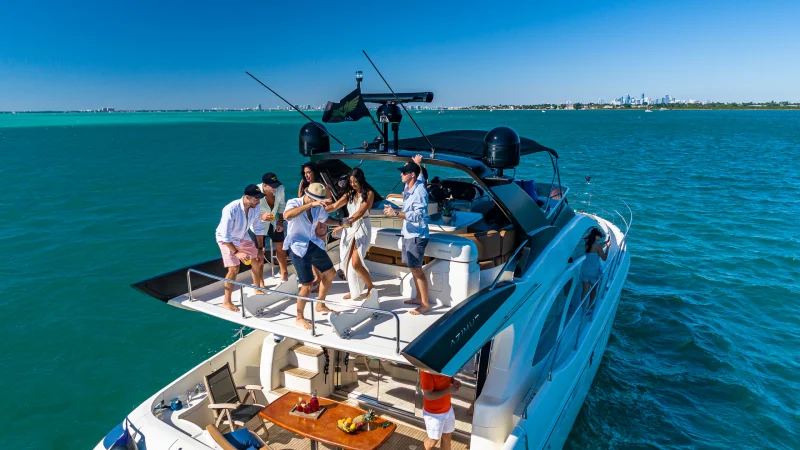
Thirteen people on a $250 an hour boat for four hours works out at $77 each. That's a good afternoon for the price of dinner, and it's the number that gets your group to say yes. Here's how to work out the real figure, pick a fair way to divide it, and collect the money before the deposit falls due.
Key Takeaways
A full boat is what makes the per-person number work. Empty seats cost everyone.
Split the delivered total, not the base rate. Fuel, tip and food all belong in the pot.
Three methods work: even split, tiered split, or host-covered with contributions.
Collect before the deposit deadline. That date is your forcing function.
Set the no-refund-after-deposit rule before anyone pays, not after someone drops out.
What Each Person Actually Owes
Divide the boat by the heads and the answer is usually better than people expect. Here's a four-hour booking across three real listings.
Boat | 4-hour base | 6 guests | 10 guests | 13 guests |
|---|---|---|---|---|
$580 | $97 | $58 | $45 | |
$720 | $120 | $72 | $55 | |
$1,000 | $167 | $100 | $77 | |
$1,196 | $199 | $120 | $92 |
Look at the difference between six and thirteen guests on the same boat. Escape II drops from $167 a head to $77. Filling the last three seats saves more than downsizing the boat ever will.
The Costs to Split, Not Just the Base Rate
Here's where organizers quietly lose money. The group splits the boat, and the organizer absorbs everything else without meaning to.
Base rate. The hourly figure times your hours.
Fuel surcharge, if your route runs long. Standard bay routes are usually included.
Crew gratuity. Customary, on the base rate, and paid in cash on the day.
Catering or the food run, if you're bringing your own.
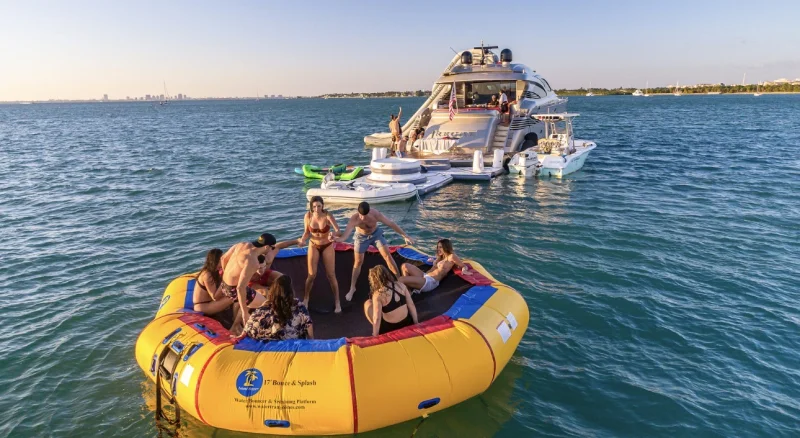
Water toys, at roughly $50 to $200 an hour per item.
Dockage if you stop somewhere else for lunch.
Tax and any booking fee, shown at checkout.
One rule fixes it. Split the total, not the headline. Add every line above, then divide.
How to Estimate the Final Cost Before Everyone Pays
You need a defensible number before you can ask anyone for money, and guessing high then refunding is a bad look. Work the booking form through to the confirmation step without paying. Every mandatory line appears there, including tax and fees.
Then add the two things the form won't show you. Gratuity, customary on the base rate, and food if you're bringing it aboard. Add a ten percent buffer on top for the fuel surcharge and anything the group decides to add on the day.
Send the buffered figure to the group and refund the difference afterwards. Collecting once and returning a few dollars is far easier than going back for a second round.
Three Ways to Divide the Bill
1. Even Split: Simplest and Most Common
Total divided by heads. It takes ten seconds and it works for the vast majority of groups.
Two situations cause friction. Guests who don't drink end up subsidizing the bar, and guests who join for half the day pay for all of it. If either applies to more than one or two people, use the tiered method instead. Otherwise, keep it simple and move on.
2. Tiered Split: Adjust for Drinkers and Add-Ons
Everyone pays a base share for the boat, fuel, and tip. Drinkers add a bar share on top, and anyone using a paid water toy covers that separately.
Worked example on a 60 ft at four hours. The $1,000 base plus $250 gratuity divided by thirteen is $96 each. A $260 bar run split across eight drinkers adds $33 to those eight. Non-drinkers pay $96, drinkers pay $129. It's the fairest method and the most admin.
3. Host-Covered With Contributions
One person books and guests contribute a fixed amount. This suits birthdays and bachelorettes where the guest of honor doesn't pay.
Set the contribution by dividing the total by the number of paying guests, not the total headcount. Twelve payers covering a $1,250 day for thirteen people is $105 each. Get that arithmetic right or the host quietly covers two shares.
The Gratuity Question
Fold it into the split. Collecting cash on the dock while everyone's finding their shoes never works, and the organizer ends up covering it.
Gratuity is customary rather than automatic, and it's calculated on the base rate rather than the full invoice with catering stacked on. Add it to the pot at the start, take it out in cash beforehand, and hand it to the captain at the end. The captain splits it with any deckhand or stewardess aboard.
Collect Before the Deposit Is Due
The deposit deadline is your friend. It gives you a real date to point at, which is the only thing that reliably moves a group chat.
1. Work out the buffered total and the per-person figure.
2. Send both to the group with the boat, the date and the times.
3. Set a payment deadline two or three days before the deposit is due.
4. Use one payment app so you can see who's paid at a glance.
5. Confirm the final headcount to the operator once the money is in.
Send the figure early rather than perfectly. A number in the chat on Monday collects far better than an exact number on Friday. (CFPB guidance on payment apps is worth a skim if you're collecting through Venmo, Zelle, or a similar app for the first time.)
What to Do When Someone Drops Out
It happens on nearly every group booking, so plan for it before anyone pays. Say this in the first message: once the deposit goes down, shares are not refundable unless somebody takes the seat.
If a drop happens early, recalculate and tell the group. If it happens late, offer the seat around before you split the shortfall. Either way the boat costs the same, so the money has to come from somewhere, and it shouldn't be the organizer.
A Sample Split Sheet
Ten guests, six hours on a 60 ft at $250 an hour, with food brought aboard.
Line | Amount | Per person |
|---|---|---|
Base rate, 6 hours | $1,500 | $150 |
Fuel surcharge, standard bay route | $0 | $0 |
Food and drinks brought aboard | $300 | $30 |
Crew gratuity, customary on base rate | $260 | $26 |
Tax and booking fees | Shown at checkout | Add at confirmation |
Buffer, 10 percent | $206 | $21 |
Collect from each guest | $2,266 | $227 |
Refund whatever the buffer doesn't absorb. Build this as a shared sheet and the group can watch the payments land, which does more for collection than any reminder.
Frequently Asked Questions
How much per person is a boat rental?
On a 40 ft boat for four hours, about $97 each for six guests and $45 for thirteen. On a 60 ft, about $167 for six and $77 for thirteen. Add roughly a quarter for gratuity, food and tax to reach a realistic delivered figure.
Who pays for the captain's tip?
The group, split evenly along with everything else. Add it to the pot at the start rather than collecting cash on the dock. It's customary on the base rate, so on a $1,000 charter budget around $150 to $200 across the group.
What if someone cancels after we book?
The boat still costs the same, so the shortfall has to be covered. Offer the seat to someone else first. If nobody takes it, recalculate and split the difference. Set that rule in writing before anyone pays and the conversation stays easy.
Should the birthday person pay?
Usually not, and the convention is that guests cover their share. Divide the total by the number of paying guests rather than the full headcount, or the host ends up quietly covering two shares. On a thirteen-person booking that's a real amount of money.
Can everyone pay the operator separately?
No. Charters use a single-payer booking model, so one person pays and holds the reservation. That's why collecting through a payment app in advance matters. Whoever books also owns the contract and the deposit, so pick someone organized.
How do you split fuel costs on a boat rental?
On a crewed charter, standard-route fuel is already in the rate, so it's inside the base split. A surcharge for a long run gets added to the pot and divided evenly. On a self-drive rental, you buy fuel outright, roughly $60 to $120 for a short trip, and split the receipt.
See the Per-Person Cost on Real Boats
Once the group sees a per-head number, the booking usually happens in an afternoon. Pick your date and guest count on our search page, divide the four-hour rate by your headcount, and send that figure to the chat. Our full cost guide covers every boat size, the large group page handles headcounts over 13, and if it's a bachelorette day you're planning, our bachelorette planning guide is worth a read too. Questions? Contact us.